Dollar Holds Firm as Gold Rebounds After Jobs Miss
 Key Takeaways:
- The dollar remains firm despite softer U.S. jobs data. Payrolls rose by just 29,000, cutting October Fed hike odds to roughly 20%–22%, but high Treasury yields continue to support the currency.
- Gold is recovering cautiously. It rose above $4,150 early Monday after a 3.59% weekly decline in October Comex futures. High yields and the prospect of a later Fed hike still cap its upside.
- Oil is the shared risk for both markets. Sustained energy inflation could keep yields and the dollar elevated, complicating gold’s rebound.
Market Summary:
The dollar began Monday firm despite a sharp change in near term Federal Reserve expectations. September U.S. payrolls rose by only 29,000, July and August employment was revised down by a combined 60,000, and annual wage growth slowed to 3.0%. Traders consequently reduced the probability of an October rate hike to roughly 20%–22%, from about 64% a week earlier. That shift initially pulled the dollar and Treasury yields lower, but the 10-year yield remained near 5.26% in early Monday trade. The jobs report has weakened the case for an immediate hike without removing the yield support behind the dollar.
The dollar’s strength also reflects pressure on other currencies. EUR/USD was around $1.124–$1.125 on Monday, near its lowest levels since May 2025, as concern over French finances and political uncertainty weighed on the euro. The dollar index was near 102, while USD/JPY traded in the upper 157s. Higher oil prices pose an additional challenge for energy importers, including Japan; however, reduced Fed hike expectations give the yen some support. For USD/JPY, the decisive question is whether U.S. yields fall enough to narrow the interest rate advantage that has favoured the dollar. uk.marketscreener.com
Gold has responded more cautiously than the initial jobs reaction suggested. It rose immediately after Friday’s payroll release, then reversed as bond yields recovered. Front-month October Comex gold settled at $4,133.70, down 3.59% for the week. By 9:50 a.m. Singapore time Monday, spot gold had risen 0.4% to $4,158.17 an ounce, while December futures reached $4,186.40. The softer labour data lowers the immediate opportunity cost of holding gold, but a modest Monday rebound does not erase last week’s decline. www.wsj.com
Gold’s next move depends on how oil affects rates. A sustained easing in energy prices could reduce inflation concerns and allow Treasury yields and the dollar to soften, supporting bullion. Renewed oil disruption could instead keep inflation expectations and yields high even as investors seek safety in gold. Markets have pared October hike bets, yet Reuters reported they still saw a strong chance of a December hike in its early Monday snapshot. That leaves gold with support from the softer jobs data but continuing resistance from the broader rate outlook.
Technical Analysis
Key Takeaways:
- The dollar remains firm despite softer U.S. jobs data. Payrolls rose by just 29,000, cutting October Fed hike odds to roughly 20%–22%, but high Treasury yields continue to support the currency.
- Gold is recovering cautiously. It rose above $4,150 early Monday after a 3.59% weekly decline in October Comex futures. High yields and the prospect of a later Fed hike still cap its upside.
- Oil is the shared risk for both markets. Sustained energy inflation could keep yields and the dollar elevated, complicating gold’s rebound.
Market Summary:
The dollar began Monday firm despite a sharp change in near term Federal Reserve expectations. September U.S. payrolls rose by only 29,000, July and August employment was revised down by a combined 60,000, and annual wage growth slowed to 3.0%. Traders consequently reduced the probability of an October rate hike to roughly 20%–22%, from about 64% a week earlier. That shift initially pulled the dollar and Treasury yields lower, but the 10-year yield remained near 5.26% in early Monday trade. The jobs report has weakened the case for an immediate hike without removing the yield support behind the dollar.
The dollar’s strength also reflects pressure on other currencies. EUR/USD was around $1.124–$1.125 on Monday, near its lowest levels since May 2025, as concern over French finances and political uncertainty weighed on the euro. The dollar index was near 102, while USD/JPY traded in the upper 157s. Higher oil prices pose an additional challenge for energy importers, including Japan; however, reduced Fed hike expectations give the yen some support. For USD/JPY, the decisive question is whether U.S. yields fall enough to narrow the interest rate advantage that has favoured the dollar. uk.marketscreener.com
Gold has responded more cautiously than the initial jobs reaction suggested. It rose immediately after Friday’s payroll release, then reversed as bond yields recovered. Front-month October Comex gold settled at $4,133.70, down 3.59% for the week. By 9:50 a.m. Singapore time Monday, spot gold had risen 0.4% to $4,158.17 an ounce, while December futures reached $4,186.40. The softer labour data lowers the immediate opportunity cost of holding gold, but a modest Monday rebound does not erase last week’s decline. www.wsj.com
Gold’s next move depends on how oil affects rates. A sustained easing in energy prices could reduce inflation concerns and allow Treasury yields and the dollar to soften, supporting bullion. Renewed oil disruption could instead keep inflation expectations and yields high even as investors seek safety in gold. Markets have pared October hike bets, yet Reuters reported they still saw a strong chance of a December hike in its early Monday snapshot. That leaves gold with support from the softer jobs data but continuing resistance from the broader rate outlook.
Technical Analysis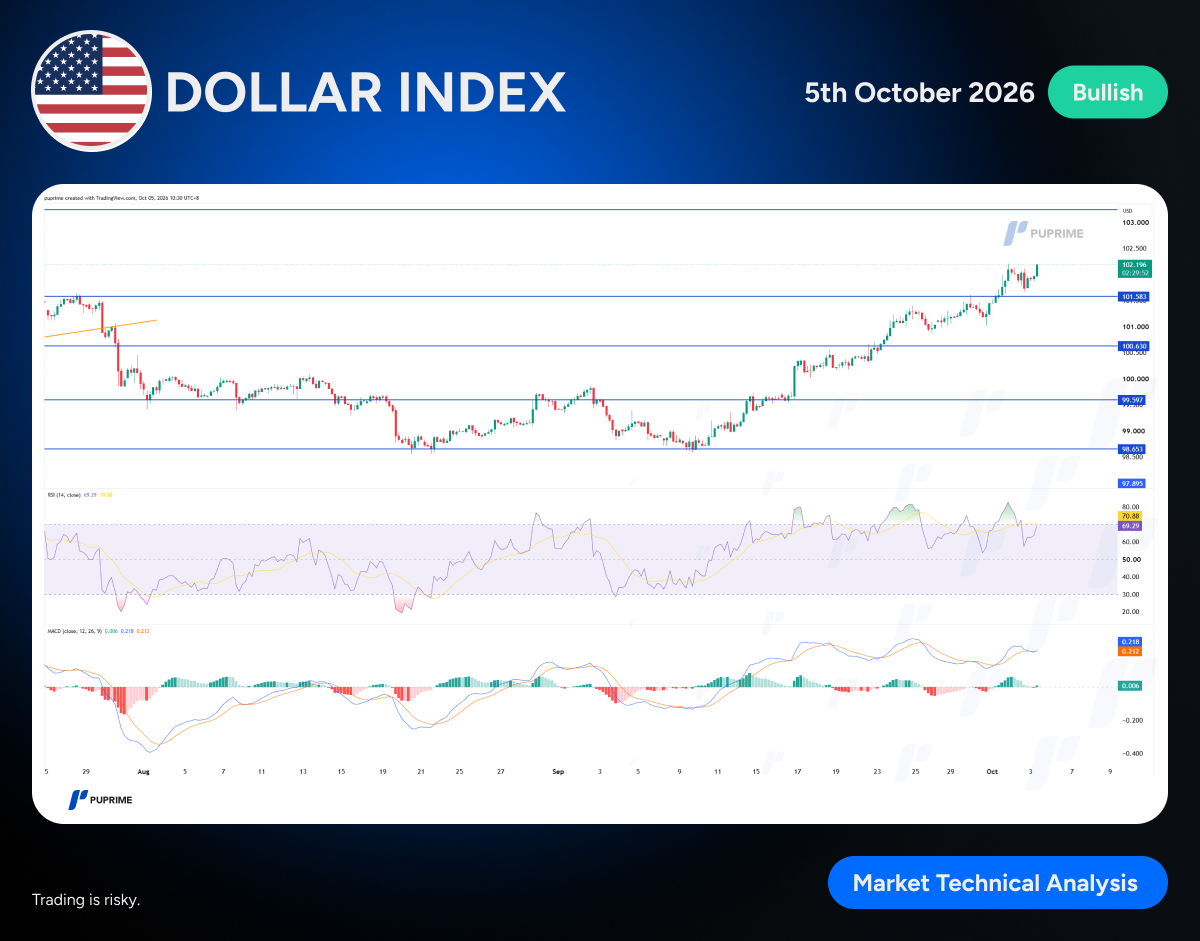 Dollar Index, H4
The Dollar Index is maintaining a strong bullish structure, with price advancing to around 102.20 after breaking above the 101.60 resistance and continuing to form higher highs and higher lows. The next key resistance is around 102.50–103.00, while 101.60 has turned into an important near-term support.
Momentum remains constructive, with RSI at around 69 and holding above 50, although it is approaching overbought territory. MACD is also positive, with the MACD line remaining slightly above the signal line and the histogram near the zero line, suggesting that bullish momentum is still intact but may be moderating. From here, a sustained break above 102.50 could extend the upside toward 103.00, while a pullback below 101.60 would weaken the immediate bullish momentum and bring 100.65 into focus.
Resistance Levels: 102.50, 103.25
Support Levels: 101.60, 100.65
Dollar Index, H4
The Dollar Index is maintaining a strong bullish structure, with price advancing to around 102.20 after breaking above the 101.60 resistance and continuing to form higher highs and higher lows. The next key resistance is around 102.50–103.00, while 101.60 has turned into an important near-term support.
Momentum remains constructive, with RSI at around 69 and holding above 50, although it is approaching overbought territory. MACD is also positive, with the MACD line remaining slightly above the signal line and the histogram near the zero line, suggesting that bullish momentum is still intact but may be moderating. From here, a sustained break above 102.50 could extend the upside toward 103.00, while a pullback below 101.60 would weaken the immediate bullish momentum and bring 100.65 into focus.
Resistance Levels: 102.50, 103.25
Support Levels: 101.60, 100.65Publication date:
2026-10-05 10:31:30 (GMT)