Yen Fights Back Against Dollar Dominance. Forecast as of 15.10.2026
By Dmitri Demidenko, Reviewed by Jana Kane
 Major Takeaways
- The US dollar weakened as expectations of a rate hike increased.
- Verbal intervention helped support the yen.
- BoJ hawks are calling for an end to the central bank's cautious approach.
- A pullback to 156.85 or 156.55 could offer a buying opportunity.
Weekly Fundamental Forecast for Yen
Words can carry more weight than actions when delivered at the right moment. Verbal intervention by Japanese authorities, coupled with increasingly hawkish rhetoric from the Bank of Japan, sent the USD/JPY plummeting. Yet the move would likely have been far less pronounced without a broader US dollar sell-off, triggered by a sharp decline in the perceived odds of a Fed rate hike in October from 50% to just 25%.
Expectations for Fed Funds Rate
Major Takeaways
- The US dollar weakened as expectations of a rate hike increased.
- Verbal intervention helped support the yen.
- BoJ hawks are calling for an end to the central bank's cautious approach.
- A pullback to 156.85 or 156.55 could offer a buying opportunity.
Weekly Fundamental Forecast for Yen
Words can carry more weight than actions when delivered at the right moment. Verbal intervention by Japanese authorities, coupled with increasingly hawkish rhetoric from the Bank of Japan, sent the USD/JPY plummeting. Yet the move would likely have been far less pronounced without a broader US dollar sell-off, triggered by a sharp decline in the perceived odds of a Fed rate hike in October from 50% to just 25%.
Expectations for Fed Funds Rate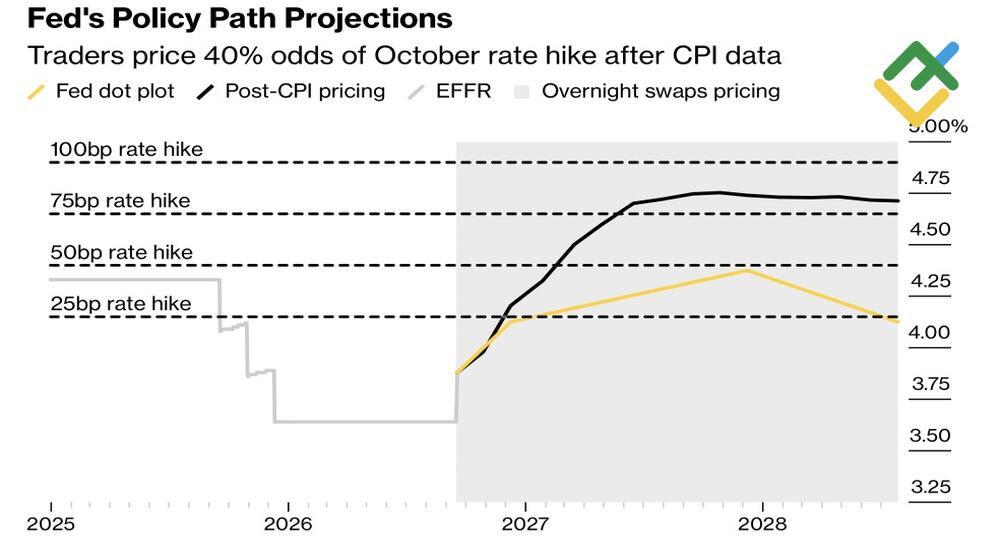 Source: Bloomberg.
Threats of intervention in the foreign exchange market are the Japanese government’s last resort to support the yen, though not necessarily its most effective tool. With the USD/JPY surging to 159 following the release of September's US inflation data, Finance Minister Satsuki Katayama’s verbal warnings came as little surprise. She stressed that the authorities were prepared to sell foreign currency if necessary.
Meanwhile, BoJ Board Member Junko Koeda backed USD/JPY bears, arguing that the central bank should not be overly cautious about tightening monetary policy. Financial conditions remain accommodative, increasing the risk of accelerating inflation. Indeed, despite a modest slowdown in September, Japanese producer prices remain near multi-year highs.
Japan's Producer Prices
Source: Bloomberg.
Threats of intervention in the foreign exchange market are the Japanese government’s last resort to support the yen, though not necessarily its most effective tool. With the USD/JPY surging to 159 following the release of September's US inflation data, Finance Minister Satsuki Katayama’s verbal warnings came as little surprise. She stressed that the authorities were prepared to sell foreign currency if necessary.
Meanwhile, BoJ Board Member Junko Koeda backed USD/JPY bears, arguing that the central bank should not be overly cautious about tightening monetary policy. Financial conditions remain accommodative, increasing the risk of accelerating inflation. Indeed, despite a modest slowdown in September, Japanese producer prices remain near multi-year highs.
Japan's Producer Prices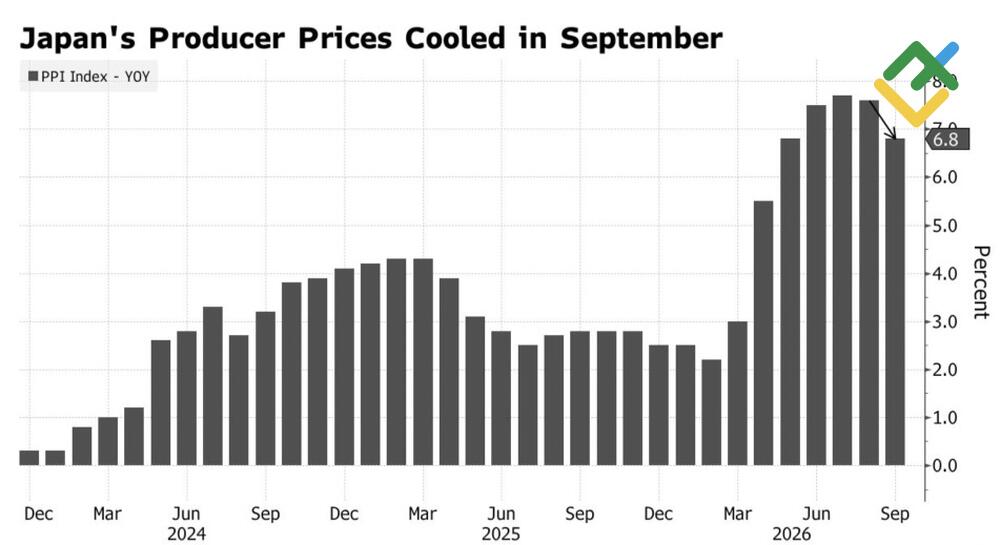 Source: Bloomberg.
Nevertheless, Bloomberg reports that the Bank of Japan is in no hurry to resume monetary tightening at its next meeting. Following September’s rate hike, the central bank has already delivered its fastest pace of tightening since 1990. That said, the outlook could change at any moment, even just hours before the next policy meeting. For now, derivatives markets put the odds of a rate hike in October at just 5%, rising to 87% in December.
For the Fed, the corresponding probabilities stand at 29% and 91%, respectively. In other words, markets expect both central banks to continue tightening at a broadly comparable pace. Given the substantial yield spread between US and Japanese bonds, this supports a sustainable USD/JPY uptrend. The recent decline, triggered by the Japanese government’s verbal interventions and the BoJ’s hawkish rhetoric, may therefore prove to be little more than a correction.
The long-term outlook for USD/JPY, however, is a different story. Viewed through the same yield-spread lens, the yen appears undervalued. Bloomberg expects the BoJ's overnight rate to rise from 1.5% to 2% by 2027, while the federal funds rate is projected to decline from 4.25% to 4%. This divergence could favor the yen next year, limiting the USD/JPY’s longer-term upside.
Weekly USDJPY Trading Plan
It is still too early to call an end to the USD/JPY uptrend. If the price returns above 158.10, or rebounds from the support at 156.85 or 156.55, long positions can be opened on the USD/JPY.
This forecast is based on the analysis of fundamental factors, including official statements from financial institutions and regulators, various geopolitical and economic developments, and statistical data. Historical market data are also considered.
Source: Bloomberg.
Nevertheless, Bloomberg reports that the Bank of Japan is in no hurry to resume monetary tightening at its next meeting. Following September’s rate hike, the central bank has already delivered its fastest pace of tightening since 1990. That said, the outlook could change at any moment, even just hours before the next policy meeting. For now, derivatives markets put the odds of a rate hike in October at just 5%, rising to 87% in December.
For the Fed, the corresponding probabilities stand at 29% and 91%, respectively. In other words, markets expect both central banks to continue tightening at a broadly comparable pace. Given the substantial yield spread between US and Japanese bonds, this supports a sustainable USD/JPY uptrend. The recent decline, triggered by the Japanese government’s verbal interventions and the BoJ’s hawkish rhetoric, may therefore prove to be little more than a correction.
The long-term outlook for USD/JPY, however, is a different story. Viewed through the same yield-spread lens, the yen appears undervalued. Bloomberg expects the BoJ's overnight rate to rise from 1.5% to 2% by 2027, while the federal funds rate is projected to decline from 4.25% to 4%. This divergence could favor the yen next year, limiting the USD/JPY’s longer-term upside.
Weekly USDJPY Trading Plan
It is still too early to call an end to the USD/JPY uptrend. If the price returns above 158.10, or rebounds from the support at 156.85 or 156.55, long positions can be opened on the USD/JPY.
This forecast is based on the analysis of fundamental factors, including official statements from financial institutions and regulators, various geopolitical and economic developments, and statistical data. Historical market data are also considered. Publication date:
2026-10-15 10:46:55 (GMT)